
Five ingredients. No cream. No garlic. No peas, no mushrooms, no parsley. Spaghetti carbonara is one of the simplest dishes in Italian cooking, and one of the most often ruined. Here is where it really comes from, why so many restaurants get it wrong, and a recipe that gets it right.
A surprisingly young dish
Carbonara feels ancient, but it isn't. There is no written record of the dish before the Second World War. It does not appear in Ada Boni's 1930 La Cucina Romana, the standard book on Roman cooking of its day.
The name first appears in print in July 1950, when the Italian newspaper La Stampa described American officers seeking out "spaghetti alla carbonara" in the restaurants of Trastevere, in Rome. The first known written recipe came two years later, oddly, in English: a 1952 Chicago restaurant guide by Patricia Bronté.
Italy's first published recipe followed in August 1954 in the magazine La Cucina Italiana. It would horrify a Roman today: pancetta, garlic and Swiss Gruyère. The same year, the British writer Elizabeth David included carbonara in her book Italian Food. Guanciale, the cured pork cheek now considered essential, first appears in Luigi Carnacina's La Grande Cucina in 1960. Pecorino took a few more years to become standard.
So who invented it?
Nobody knows for certain, and there are three popular stories.
- The charcoal burners. Carbonaro means charcoal burner. The story goes that woodsmen in the Apennines cooked pasta with cured pork, cheese and eggs, and that the black pepper looks like flecks of coal dust. Charming, but there is no written evidence.
- The American soldiers. After the Allies liberated Rome in 1944, GIs had bacon and powdered egg in their rations. Roman cooks, the theory goes, combined these with local pasta and cheese. The timing fits the first printed mentions perfectly.
- A wartime cook's claim. A Bolognese chef, Renato Gualandi, said he served a version to Allied officers in 1944. It is a good story, but hard to verify.
The honest answer: carbonara was most likely born in Rome in the 1940s, from Roman ingredients and Roman technique, possibly nudged along by American appetites. What matters more is what it became.
What authentic carbonara contains
Today's Roman carbonara is settled, and it is strict:
- Guanciale: cured pork jowl. Fattier and more deeply flavoured than pancetta, and it renders into crisp, chewy pieces.
- Pecorino Romano: a sharp, salty sheep's milk cheese. Some cooks mix in a little Parmigiano Reggiano to soften it.
- Eggs: mostly yolks, for richness and colour.
- Black pepper: plenty of it, freshly ground.
- Pasta: spaghetti is classic; rigatoni and tonnarelli are common in Rome.
That is the whole list. The "cream" in a carbonara comes from emulsion: egg, cheese, rendered pork fat and starchy pasta water, whisked together into a glossy sauce.
Why carbonara is so badly done in so many places
The most common faults in restaurants outside Italy:
- Cream. Usually a lot of it, sometimes instead of egg. The result is closer to an Alfredo sauce with bacon.
- Smoked bacon or ham instead of guanciale. Smoke overwhelms the dish, and ham never crisps.
- Garlic, onion, mushrooms, peas, parsley or chicken. All perfectly nice. None of them carbonara.
- Scrambled eggs. Egg added over direct heat sets into lumps instead of a sauce.
- Cheap pre-grated cheese that clumps rather than melts.
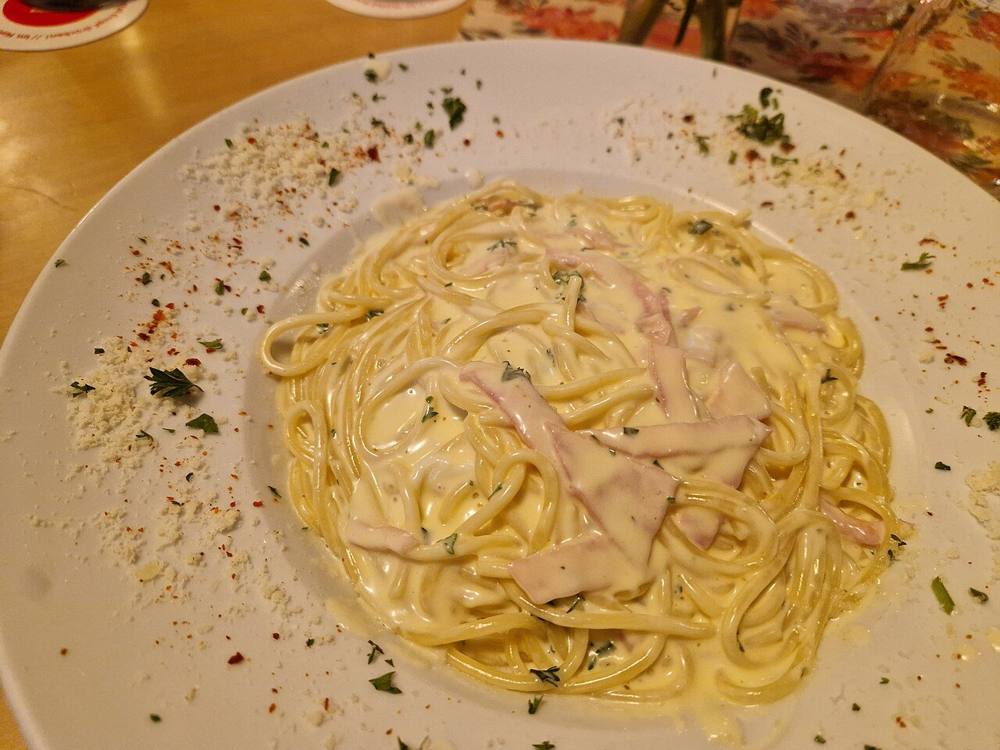 Cream, ham and parsley: popular, but not carbonara. Photo: Wikimedia Commons, CC0
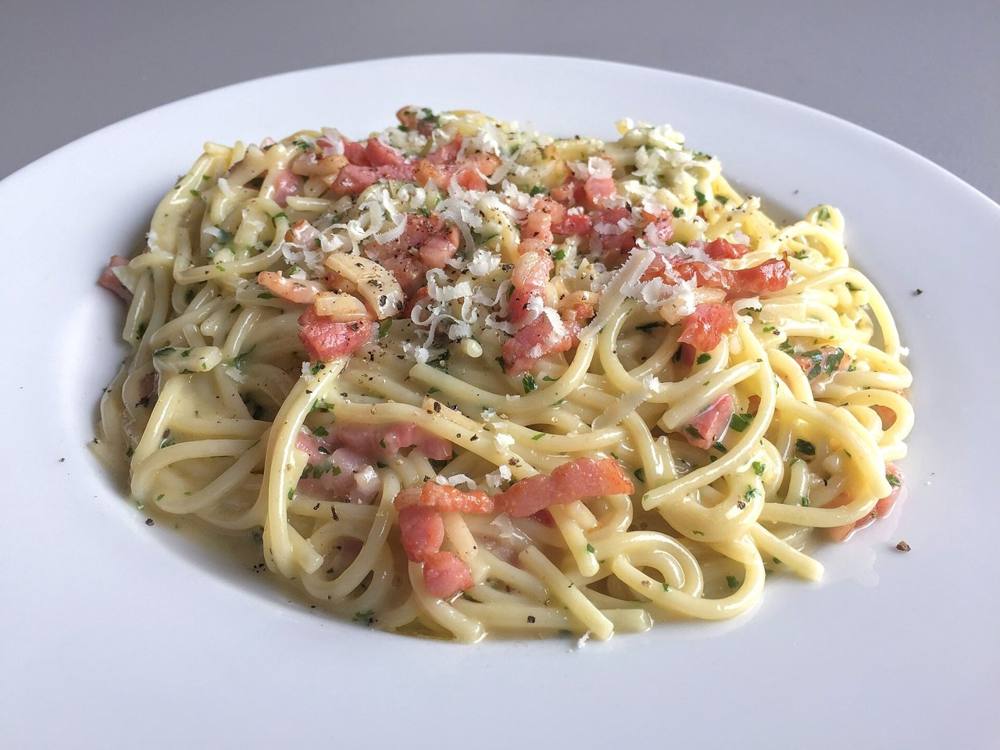 Smoked bacon bits and herbs: another common shortcut. Photo: Amin / Wikimedia Commons, CC BY-SA 4.0
The cream question
Ask a Roman to put cream in carbonara and you will get a look. In Rome, as in most of central and southern Italy, cream simply isn't used in pasta sauces like this. It is a later addition, and almost all Italian food authorities reject it today.
To be fair, cream wasn't always taboo. Recipes with cream turned up in Italy and abroad through the 1970s and 1980s. So why do so many kitchens still use it?
- It's foolproof. Cream stops the egg from scrambling, so any cook can make it without skill or timing.
- It holds. A cream sauce can sit on a pass or under a heat lamp. A true carbonara has to be eaten within a minute or two.
- It's cheap. Cream bulks out the sauce and stretches expensive guanciale and Pecorino.
- It's what people expect. Many diners abroad grew up with the creamy version and assume that is the real thing.
The trouble is that cream dulls everything carbonara is about: the bite of the Pecorino, the savoury pork fat, the heat of the pepper. You end up with something heavy and bland. Proper carbonara is rich but lively. Once you have had it, the cream version tastes like a different dish, because it is.
Authentic spaghetti carbonara recipe
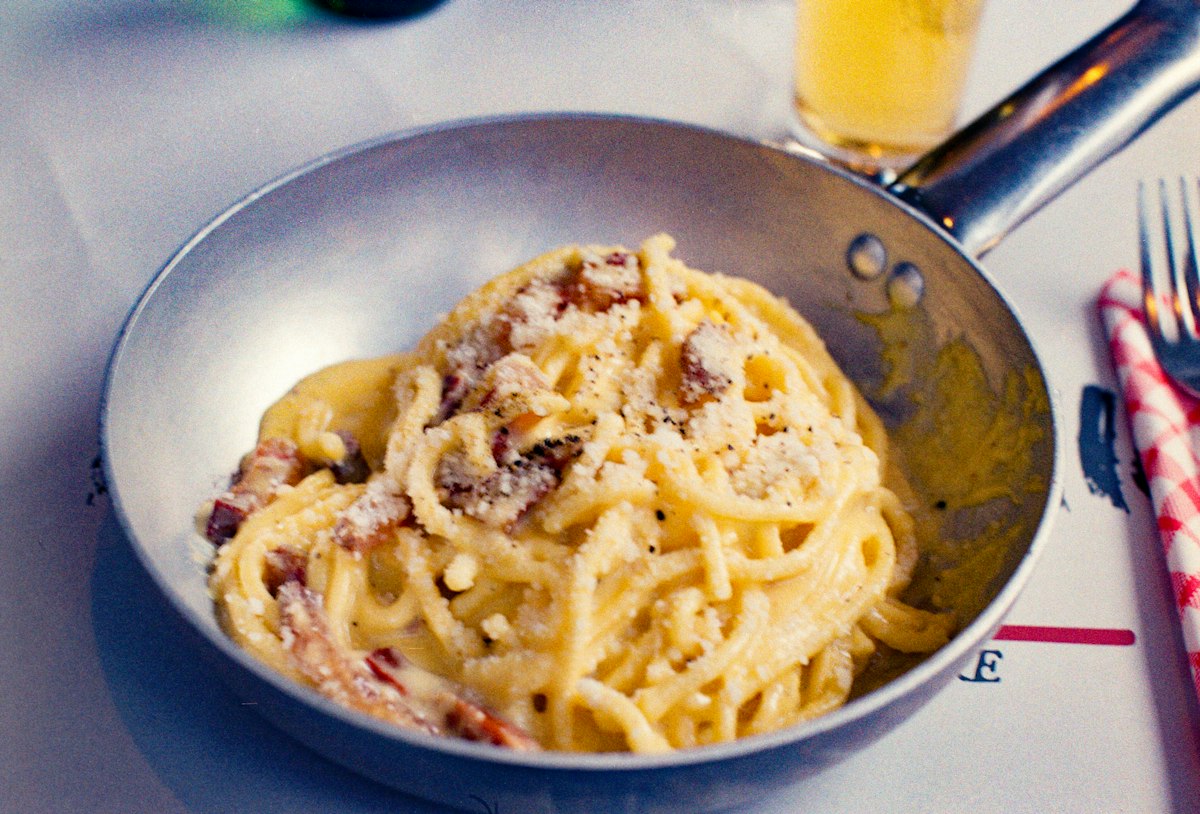 Toss it in the pan, off the heat, until glossy. Photo: Chris Weiher / Unsplash
Serves 2 · Prep 10 minutes · Cook 15 minutes
Ingredients
- 200 g spaghetti (bronze-cut if you can find it)
- 100 g guanciale
- 3 egg yolks plus 1 whole egg, at room temperature
- 50 g Pecorino Romano, very finely grated, plus extra to serve
- 1 to 2 tsp freshly ground black pepper
- Salt for the pasta water
Method
- Prepare the guanciale. Cut off the hard outer skin, then slice into strips about 1 cm thick and 3 cm long.
- Render it slowly. Put the guanciale in a cold, wide frying pan with no oil. Cook over medium-low heat for 8 to 10 minutes, until the fat runs and the edges turn golden and crisp. Turn off the heat.
- Boil the pasta. Cook the spaghetti in a large pot of boiling water. Salt it lightly: the guanciale and Pecorino are both salty. Cook 1 minute short of the packet time.
- Make the cream. While the pasta cooks, whisk the yolks, whole egg, Pecorino and most of the pepper into a thick paste. Loosen it with a tablespoon of hot pasta water.
- Combine. Move the pasta straight into the pan with the guanciale and its fat, with a splash of pasta water. Toss over low heat for 30 seconds so every strand is coated.
- Add the egg off the heat. Take the pan off the heat and wait about 30 seconds. Pour in the egg mixture and toss hard, adding pasta water a spoonful at a time until the sauce is glossy and coats the pasta. It should flow, not clump.
- Serve at once. Twirl onto warm plates. Finish with more Pecorino, the remaining pepper and a few crisp pieces of guanciale on top.
Tips for getting it right
- Scared of scrambling? Toss the pasta and egg in a heatproof bowl set over the pot of simmering water. The gentle heat thickens the sauce safely.
- Grate the cheese finely. A microplane gives a fine snow that melts smoothly.
- Save more pasta water than you think. A cup is plenty; you can always add, never take away.
- Can't find guanciale? Unsmoked pancetta is the accepted substitute. Smoked bacon changes the dish, so call it something else.
- No cream. Ever. If the sauce is too thick, add pasta water. If it's too thin, toss a little longer.
Where to eat proper carbonara
Carbonara is a good test of an Italian kitchen. If it arrives creamy, with ham and parsley, you know what you're dealing with. Browse Italian restaurants in Jakarta, Bali, Singapore, Bangkok, Kuala Lumpur, Hong Kong, Phuket, Koh Samui and Lombok, or see every Italian restaurant in the guide, and look for the places that do it the Roman way.
Carbonara Day is celebrated every year on 6 April. A good excuse to make it properly.